






- Unitree shares plunged nearly 45% after a huge 460% IPO-day surge.
- The reversal sparked bubble fears around China’s AI and robotics stocks.
- Unitree has strong shipments but weak profits, with Q1 adjusted net profit down 53%.
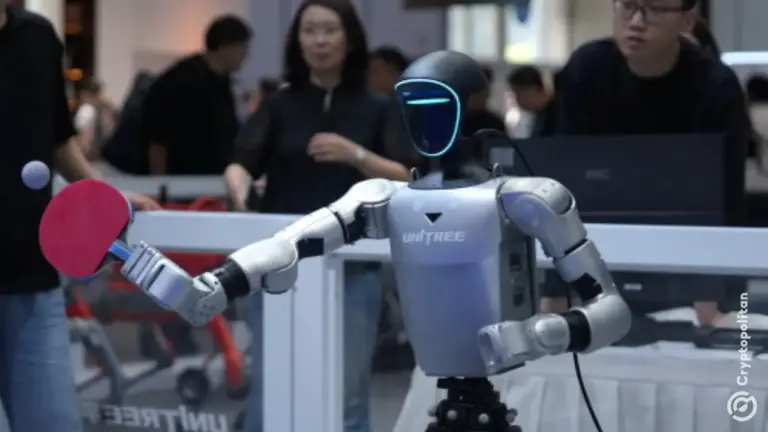
Unitree, the most popular manufacturer of humanoid robots in China, has seen its shares go down by almost 45% after debuting on the Shanghai Stock Exchange on August 19, 2026. The downturn brings into question whether the enthusiasm surrounding artificial intelligence and robotics has been overvalued.
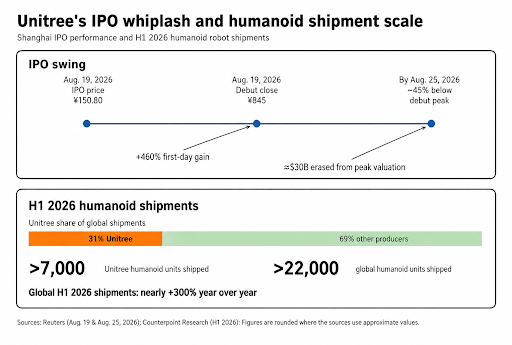
Unitree reportedly experienced a spike of 460% on its first day of trading and briefly reached a valuation of $66 billion. The price stabilized on August 25 after three consecutive down trading sessions wiped $30 billion off the peak value. The turnaround seemed to fund managers and bankers to be less of an assessment of Unitree’s technology than a cautionary sign about how fast investors are drawn to the robotics story.
A $30 billion swing that unsettled the bulls
What attracted the focus is the size of the move. According to reports, Chinese IPOs delivered an average first-day return of 226% in the last three years – what Unitree has achieved is double that figure. A month before Unitree’s success, chipmaker CXMT saw its stock price rise by 466% upon debuting in Shanghai, showing that interest encompasses much more than just robotics.
“Investors were carried away by the technology revolution narrative,” Dong Baozhen, chairman of Beijing asset manager Lingtong Shengtai, told Reuters, adding that “all bubbles are doomed to burst.”
According to Abraham Zhang, chairman of the venture company China Europe Capital, the IPO was motivated solely by a need “to pump up the shares so as to dump them later at lofty prices.” He also maintained that the IPO engaged common shareholders who are left to take losses, while those who have benefited from the IPO make money.
Profit shrank while the share price ballooned
Financial information backs up the responses of skeptics. According to the report from Unitree, the company made 1.699 billion yuan, around $250 million, in revenue in 2025 and earned a gross margin of 60.13% for its core businesses, according to figures disclosed to the Global Times ahead of its IPO evaluation. This margin indirectly disproves the idea that humanoids are nothing but money consumers.
Still, adjusted net profit fell 53% to 40 million yuan, or about $5.95 million, in the first quarter of 2026, its prospectus showed. Unitree’s machines are famous for running, dancing and performing martial-arts kicks, but paying commercial work remains scarce. Gao Xingkun of China Southern Asset Management says in comparing robotics to the early, loss-heavy years of China’s now-dominant electric-vehicle industry:
“It’s not fair if you only look at profit,”
How China’s listing rules can bend the price
Much of the criticism is directed towards the market structure itself. Chinese exchanges screen companies before their IPO and guide the pricing of IPOs, restricting how much the banks can change prices in response to the upsurge in interest, Reuters said. It has earlier been noted by Cryptopolitan that state-funded investors in China have supported the humanoid industry, which means that the perception that the rapid introduction of Unitree’s IPO at the STAR market has been done with the approval of the government remains.
There are two characteristics that make mispricing difficult to rectify: the limited presence of short-sellers and investors presumed that regulators would protect minority shareholders. According to bankers interviewed by Reuters, the effect is that a high-priced IPO could go unchallenged.
Hedge fund manager Yuan Yuwei of Trinity Synergy puts it plainly:
“An IPO stock worth 10 yuan can open at 100 yuan, before sliding for years. It’s a rip-off.”
Supply is also tight. Just 21 companies were listed in Shanghai during the first seven months of 2026, compared with 104 in Hong Kong.
Real shipments, unproven demand
Unitree is not a paper company. It is the world’s largest maker of robot dogs and the second-biggest humanoid producer by shipments. Counterpoint Research said Unitree shipped more than 7,000 humanoid robots in the first half of 2026, giving it 31% of the global market. Worldwide shipments topped 22,000 units over the same period, up nearly 300% year on year.
Even founder Wang Xingxing has urged patience. On August 20, one day after the IPO, the CEO said the field was nearing a “ChatGPT moment” for robot intelligence, while cautioning that the real software leap could still be two to three years away in an optimistic scenario, or five to 10 years at the latest.
That tension now defines Unitree: investors are pricing in a robotics future that the technology has not fully delivered.
Don’t just read crypto news. Understand it. Subscribe to our newsletter. It's free.
FAQs
Why did Unitree's stock fall so sharply after its IPO?
After surging more than fivefold and closing up 460% on its Shanghai debut, the shares fell for three consecutive sessions, losing about 45%, as fund managers warned the pop reflected market froth and speculative "pump" behavior rather than the company's fundamentals.
How profitable is Unitree right now?
Unitree reported 2025 revenue of 1.699 billion yuan (about $250 million) with core gross margins above 60%, but its adjusted net profit fell 53% to 40 million yuan (roughly $5.95 million) in the first quarter of 2026, according to its prospectus.
What is the STAR Market and why did investors chase the listing?
The STAR Market is Shanghai's tech-focused board reserved for firms in China's strategic hard-tech industries; analysts told Reuters that Unitree's fast-tracked listing there was read as a signal of government backing, drawing investors amid the US-China race for tech supremacy.
Disclaimer. The information provided is not trading advice. Cryptopolitan.com holds no liability for any investments made based on the information provided on this page. We strongly recommend independent research and/or consultation with a qualified professional before making any investment decisions.

Ashish Kumar
Ashish Kumar is a crypto and financial journalist with eight years of newsroom experience. He covers what’s happening with crypto markets, regulation, DeFi, and exchange ecosystems. He has worked with Coingape, Todayq, and Newsroompost. Ashish holds a PGDP in English Journalism from the IIMC. He has also interviewed industry figures including Arthur Hayes, Yat Siu, Austin Federa, and more.









