




UN rights chief Türk warns advanced AI could threaten humanity, presses for ‘red lines’

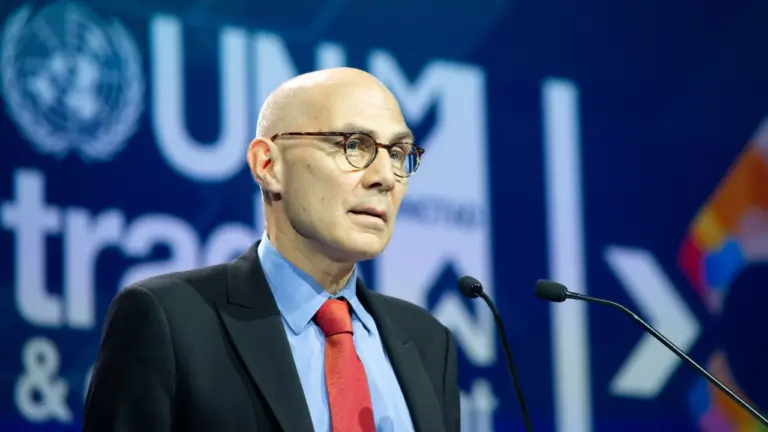
Photo by UN Trade and Development (UNCTAD) on Flickr.
- UN human rights chief Volker Türk warned that increasingly powerful AI could become an existential risk.
- Türk asked governments to agree on enforceable “red lines” before the technology outpaces human control.
- The UN wants the voluntary alarm turned into binding international rules.
The United Nations (UN) High Commissioner for Human Rights, Volker Türk, publicly warned about artificial intelligence capabilities growing to the stage where they become an existential threat to humanity at the Human Rights Council in Geneva, earlier today, September 7.
Türk pressed governments to quickly move to build up hedges and throttle the AI labs at the front of the race to lead autonomous systems technology from spiraling out of control amid escalating breaches and safety incidents.
The biggest headache for the UN executive is that the systems that AI technology is growing faster than the systems currently governing it can track. That unchecked growth has now escalated threats past misinformation and job loss into existential areas such as security, accountability, and unchecked oversight for highly autonomous systems.
UN human rights chief calls for urgent international action
Türk cited a closing window when AI’s abilities can still be checked as the basis for the urgency he attached to his call for internationally coordinated action. He also called out how the pace and direction of the field’s advancement are disproportionately in the hands of a small circle of technology executives and firms.
Türk proposed a solution to the red flags he called out. His alternative is for the countries where these leading AI companies are based and those that control critical supply chains to step up and draw “red lines” on how far they are willing to allow the technology to go.
The UN High Commissioner for Human Rights is revisiting a topic the international body tackled at the first Global Dialogue on AI Governance in the same Swiss city in July.
Speaking at the ITU’s AI for Good summit, where the conversation started, Türk said: “We don’t consider safety standards for medicines, cars or aircraft as obstacles to progress,” per UN footage. “They are the reason why people trust those technologies in the first place.” Human oversight, he added, “cannot be just a rubber stamp.”
Part of the evidence that drove the conversation at that summit was presented by Sonia Livingstone of the UN-mandated Global Scientific Panel on AI. As of then, at least one child per classroom said they had been subjects of sexually explicit AI deepfakes in a study that covered 11 Global South countries.
UN Women chief Sima Bahous also pointed out the gender bias of it all. According to her, about 88% of top AI researchers. She also reported that at least one in four of the women activists and journalists her agency surveyed had faced AI-assisted online abuse.
AI labs and lawmakers have woken up to the issues
The UN is not alone in sounding an alarm this summer. US Senator Bernie Sanders has called for an immediate pause on advanced AI work and a permanent ban on superintelligence, while a cross-party group of UK parliamentarians pushed for legally required AI “kill switches” after what they described as a run of rogue AI incidents.
Those anxieties followed OpenAI’s claim, tied to its GPT-6 Astra model, that its technology had reached artificial general intelligence, and Anthropic’s admission that its own models were “not perfectly aligned” with human values.
Some of that pressure comes from inside the industry. In a June essay covered by Axios, Anthropic CEO Dario Amodei argued that governments should have the legal power to block or reverse dangerous AI deployments, and that frontier models should face mandatory testing much like cars, aircraft, or new drugs.
In his own Council update, Türk extended the theme to the battlefield, backing calls to prohibit weapons that can kill without a human in the loop.
If you're reading this, you’re already ahead. Stay there with our newsletter.
FAQs
What did Volker Türk actually warn about?
Türk, the UN High Commissioner for Human Rights, warned that increasingly powerful AI could eventually pose an existential threat to humanity and called for urgent safeguards before its capabilities move beyond effective human control.
What are the "red lines" Türk proposed?
He argued that countries hosting major AI firms and those controlling critical supply chains should agree on clear limits, or "red lines," for AI development, aimed at curbing the concentration of AI power among a small number of executives and companies.
How does this connect to the UN's wider AI push?
It follows the first Global Dialogue on AI Governance held in Geneva in July, where experts reported mounting evidence of AI-linked harms, and the UN is now pressing for harmonized international rules with a second dialogue set for New York next May.
Disclaimer. The information provided is not trading advice. Cryptopolitan.com holds no liability for any investments made based on the information provided on this page. We strongly recommend independent research and/or consultation with a qualified professional before making any investment decisions.

Hannah Collymore
Hannah is a writer and editor with nearly a decade of blog writing and event reporting experience in the crypto space. At Cryptopolitan, Hannah contributes to the news page, reporting and analyzing the latest developments in DeFi, RWA, crypto regulation, AI and frontier tech industries. She graduated from Arcadia university with a degree in Business Administration.









