




-
South Korea’s Toss plans to launch a non-custodial crypto wallet supporting ETH, USDT and USDC for its nearly 30 million users.
-
Users can send and receive crypto without opening an exchange account or installing another app.
-
Toss is also testing USDC remittances with Solana and QR-based stablecoin payments.
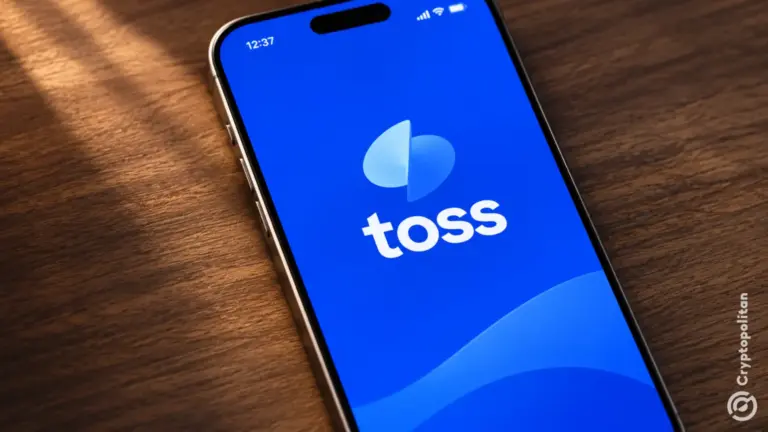
Viva Republica is planning to launch a cryptocurrency wallet via South Korea’s Toss app. On November 16, the company announced that Toss Coin Wallet would launch later that week. The service will support Ether (ETH), Tether (USDT), and USDC. This will allow Toss’s almost 30 million users to set up a non-custodial wallet without a cryptocurrency exchange account.
Viva Republica sees the product as an opportunity to grow its clientele. The product will also make dollar-backed stablecoins available to users of an app that is already used by millions for their everyday financial transactions.

No exchange account, no wallet address
Toss Coin Wallet will be added under the “Assets” menu of the existing Toss app. Users do not need to install another application or open a cryptocurrency exchange account. However, they must choose to create a wallet before using the service.
Once they have created a wallet, users can check balances, receive cryptocurrencies, and send funds through their phone contacts or external wallet addresses. Transfers will be processed through the Ethereum blockchain.
Toss will neither hold users’ cryptocurrencies nor charge its own transfer fees. However, transfers to external wallets will incur Ethereum network fees, known as gas. An unnamed Toss spokesperson said the supported cryptocurrencies were “selected based on their high trading volume and utility.”
Despite the fact that Toss has approximately 30 million registered users, not all of them use cryptocurrency wallets. It is up to each user to determine whether he/she will utilize the new service or not.
Pairing the wallet with remittance and payment trials
Toss is looking into the potential of stablecoins for international transactions and regular payments. In July, Toss and Toss Bank entered into a deal with Circle to look into payments and settlements by means of USDC.
On November 16, Toss Bank announced the results of a remittance test with the Solana Foundation. Using the Solana blockchain, USDC reached recipient wallets within tens of seconds. Chainalysis helped screen wallet addresses against US sanctions lists. However, connections with overseas partners and full identity and anti-money-laundering checks still need testing. Cryptopolitan previously reported on the Solana partnership.
Separately, Toss and Gwangju Bank proceeded to test real-world QR stablecoin payments through Toss Place payment terminals. The testing involved dummy merchants and no actual customer funds.
Both projects are still in the testing phase, and neither the stablecoin transfer service nor the QR payment service is being offered commercially.
A VASP license Toss does not yet hold
Edaily reports that Toss is preparing to register as a virtual asset service provider (VASP). However, there is no public confirmation that the company has submitted an application or received regulatory approval.
Whether Toss will have to register or not may depend on how its wallet works, especially how it handles the keys of private users. According to South Korea’s new regulations starting August 20, if non-custodial wallet service providers do not exert sole control of those keys, they may not need to seek registration. Regulators check whether a provider can make independent movements of funds, access private keys, and carry out transactions without the involvement of the user.
Seo Chang-hoon, Viva Republica’s new-business executive, told Edaily: “We are reviewing options such as transitioning to a custodial wallet in the future,” depending on regulatory changes. That could alter its registration requirements.
What it could mean for stablecoins and exchanges
Toss Coin Wallet could reduce users’ reliance on cryptocurrency exchanges for everyday transfers. However, users may still need exchanges to buy stablecoins. How much the wallet changes consumer habits will depend on actual adoption.
The market offers considerable room for growth. Grand View Research expects the global crypto-wallet market to grow from $15.5 billion in 2025 to $100.8 billion by 2033. Meanwhile, BIS research puts stablecoin value above $300 billion, with roughly 98% tied to the US dollar. Wider use could strengthen the dollar’s dominance, particularly in emerging economies.
Transaction costs remain a concern. Ethereum estimates that transferring an ERC-20 token uses 65,000 gas units. At an assumed 1 gwei and $3,000 per ETH, the fee would be about $0.20. Separately, BIS research found bank foreign-exchange markups of 2–4.7%. That equals $2–$4.70 on a $100 transfer, excluding other fees. These are illustrative comparisons, not Toss prices.
The wallet launch also comes as Viva Republica reportedly prepares for a US IPO targeting a valuation above $10 billion.
The smartest crypto minds already read our newsletter. Want in? Join them.
FAQs
What is Toss Coin Wallet and which assets does it support?
It is a non-custodial wallet built into the Toss app that lets users send, receive, and track Ether, Tether (USDT), and USD Coin (USDC) on the Ethereum network, with transfers possible via phone contacts instead of long wallet addresses.
Does Toss charge fees to use the wallet?
Toss does not charge its own fee for transfers, but users who move assets to an external wallet still pay Ethereum gas fees because the transactions settle on the Ethereum network.
Does Toss have a VASP license for this service?
No. Toss is reportedly preparing to pursue Virtual Asset Service Provider registration, and under South Korea's revised reporting rules, non-custodial wallets may be exempt depending on whether the operator controls users' private keys.
Disclaimer. The information provided is not trading advice. Cryptopolitan.com holds no liability for any investments made based on the information provided on this page. We strongly recommend independent research and/or consultation with a qualified professional before making any investment decisions.

Ashish Kumar
Ashish Kumar is a crypto and financial journalist with eight years of newsroom experience. He covers what’s happening with crypto markets, regulation, DeFi, and exchange ecosystems. He has worked with Coingape, Todayq, and Newsroompost. Ashish holds a PGDP in English Journalism from the IIMC. He has also interviewed industry figures including Arthur Hayes, Yat Siu, Austin Federa, and more.









