







- Tether signed an MoU with Kazakhstan’s central bank and the Alatau City Authority to explore a tenge-backed stablecoin and asset tokenization.
- The move comes about a month after Binance agreed to build a settlement hub with the same bank.
- Kazakhstan is advancing as a magnet for major stablecoin and exchange players leveraging Alatau’s special legal zone.
The National Bank of Kazakhstan (NBK) and the Alatau City Authority have signed a memorandum of understanding (MoU) with USDT issuer, Tether, to explore frameworks for a tenge stablecoin and real-world assets tokenization.
The deal announced by the stablecoin issuer on Wednesday, October 7, adds a new name to Kazakhstan’s push to become Central Asia’s leading crypto hub following Binance’s agreement with NBK.
Tether is exploring a tenge stablecoin and tokenization framework
According to Tether’s announcement, the stablecoin issuer is looking to develop two tracks in the agreement it penned with NBK and ACA.
- First, it will examine international models to develop a concept and a pilot proposal for a stablecoin pegged to Kazakhstan’s national currency, the tenge.
- On the second track, they are working with domestic authorities to build a tokenization framework for real-world assets, potentially using Tether’s Hadron tokenization platform.
Tether CEO Paolo Ardoino said, “Kazakhstan is taking a deliberate, forward-looking approach by exploring asset tokenization and a strategic reserve framework.”
Financial stability, transparency, and investor protection are the central bank’s top priorities in this arrangement, according to a deputy governor at the National Bank, Binur Zhalenov.
Both sides also committed to a run of workshops and training sessions for central bank and government staff, covering stablecoin issuance, reserve management, and tokenization.
Why firms are moving to Alatau, Kazakhstan
Alatau, the city run by the Alatau City Authority (ACA), is Kazakhstan’s “CryptoCity” ran under a special legal regime signed into law on May 8, 2026, by President Kassym-Jomart Tokayev. Deputy Prime Minister Kanat Bozumbayev also called Alatau a “charter city” during a May 21 briefing.
Kazakh outlet Qazinform reports that the special legal regime framework, partly modeled after Dubai and Singapore, took effect in stages starting July 1.
Disputes can be resolved through the Astana International Financial Centre (AIFC) or international arbitration, and local rules can draw on the law of England and Wales.
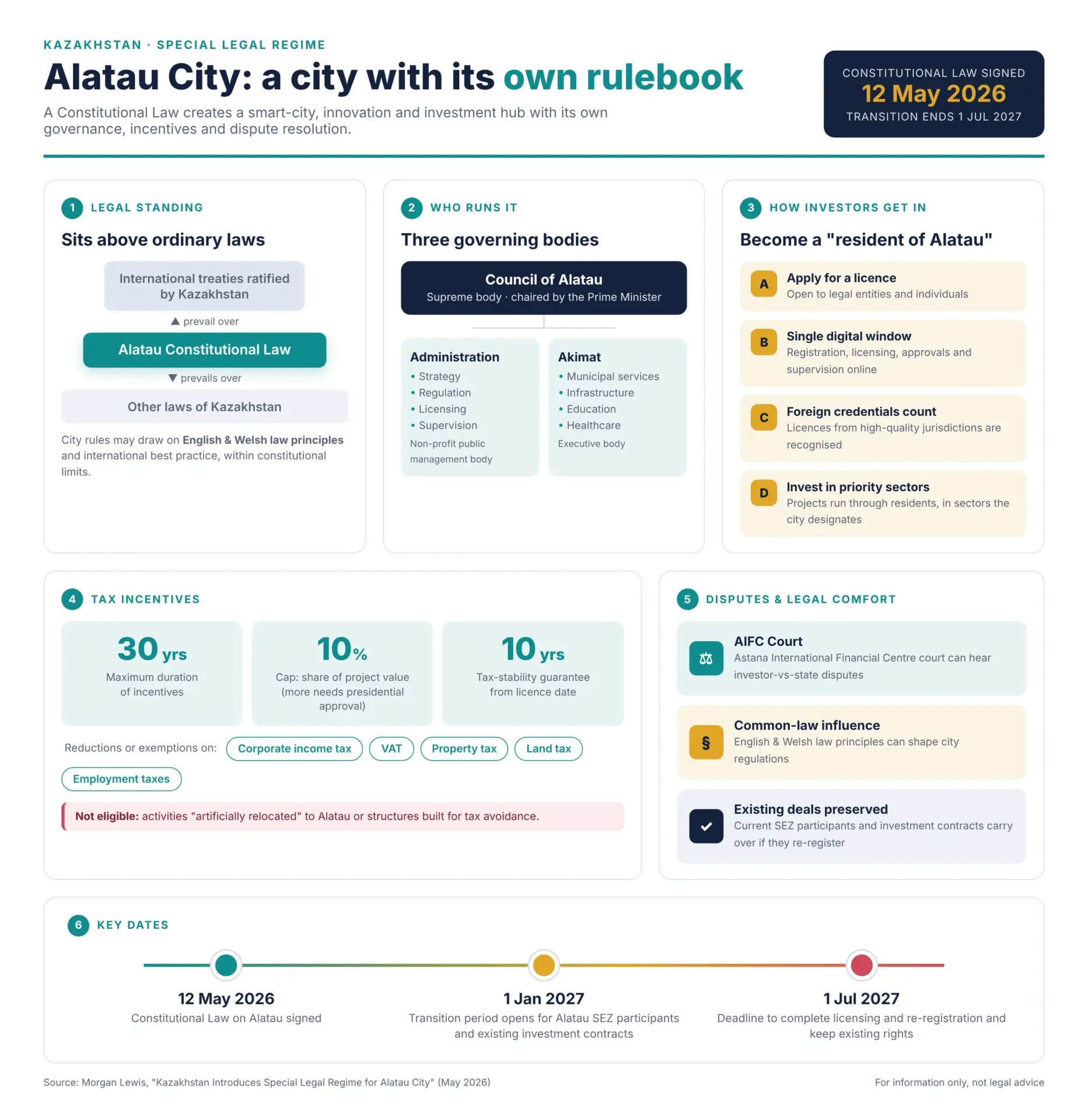
Notably, Bozumbayev said the successes from CryptoCity could be deployed on a larger scale throughout Kazakhstan.
Tether is following Binance to Alatau, after the exchange signed a September 7, 2026, memorandum with the National Bank of Kazakhstan to build a regional settlement hub in the country, as Cryptopolitan reported at the time.
Binance had a local presence even before that September MoU, as its Binance Pay service went live across 5,000 point-of-sale terminals through Alatau City Bank. Co-founder Changpeng Zhao (CZ) announced the milestone on July 8, 2026. That system converts digital assets, mostly USDT, into tenge instantly for merchants.
The smartest crypto minds already read our newsletter. Want in? Join them.
FAQs
What did Tether agree to do in Kazakhstan?
Tether signed a memorandum of understanding with the National Bank of Kazakhstan and the Alatau City Authority to study a tenge-pegged stablecoin, build an asset tokenization framework, and run pilots inside the city of Alatau, potentially using its Hadron platform.
How is this connected to Binance's deal in Kazakhstan?
Binance signed its own memorandum with the National Bank on September 7, 2026, to create a regional settlement hub for Central Asia, the CIS, and Eastern Europe, placing Tether's agreement roughly a month behind a rival's move with the same regulator.
What is Alatau and why does it matter for crypto?
Alatau is a Kazakh charter city with a special legal regime signed into law on May 8, 2026, and home to a "CryptoCity" pilot zone first announced by President Tokayev in 2025, where digital-asset payments and tokenization projects can be tested under state oversight.
Disclaimer. The information provided is not trading advice. Cryptopolitan.com holds no liability for any investments made based on the information provided on this page. We strongly recommend independent research and/or consultation with a qualified professional before making any investment decisions.

Hannah Collymore
Hannah is a writer and editor with nearly a decade of blog writing and event reporting experience in the crypto space. At Cryptopolitan, Hannah contributes to the news page, reporting and analyzing the latest developments in DeFi, RWA, crypto regulation, AI and frontier tech industries. She graduated from Arcadia university with a degree in Business Administration.









