





Kava to shut HARD Lend after $3.76M exploit of a BUSD market left open for years


- An attacker drained tens of millions of KAVA from HARD Lend by exploiting a BUSD market that Kava kept running years after the stablecoin was wound down.
- Kava Chain put the loss at about 53.9 million KAVA, worth roughly $3.67 million.
- It is now moving to permanently shut down the protocol’s lending through a governance vote.
Kava Chain has announced plans to permanently shut down its HARD Lend protocol, according to the project’s incident report confirming the loss of 53.9 million KAVA tokens in a November 14 attack.
The project said it will ask KAVA holders to approve the shutdown of its legacy BUSD collateral market.
How did the Kava Chain exploit happen?
The flaw that caused the Kava Chain hack sat inside the BUSD market on HARD Lend. Paxos stopped minting and Binance wound down support for the stablecoin named after it in February 2024 following a 2023 order by New York regulators.
The lack of activity on the BUSD pool was exactly what the attacker needed to execute the November 14 attack.
Per Kava’s public code, HARD Lend calculates depositors’ earnings by dividing borrowers’ interest against the market’s net supply. While the code skips the math when supply reads exactly zero, it does not account for cases where the figure is barely above zero.
The attacker exploited that flaw, using a small loan to cut the BUSD market’s net supply down to a tiny fraction of a cent. The BUSD the attacker parked in advance suddenly counted as roughly 1.25 billion BUSD in collateral, as HARD Lend revalued every BUSD deposit by about 243,000 times, as the hacker expected.
The next step of the attack occurred across 127 separate KAVA loans, with a second wallet clearing each loan to slip past the protocol’s borrowing cap. Reports found test runs of repeated deposits and borrowing dating back to November 8.
About 49.2 million of the stolen 53.9 million KAVA tokens were sold for roughly $2.1 million in BNB and USDT within an hour of landing on BNB Chain through Kava’s LayerZero bridge. With KAVA trading around $0.068 before the attack, the dollar figure of the theft comes close to $3.67 million.
Kava Chain’s November 16 incident report notes that the team is working with ecosystem contributors, exchanges and law enforcement to trace and claw back more funds after successfully freezing part of the thief’s loot.
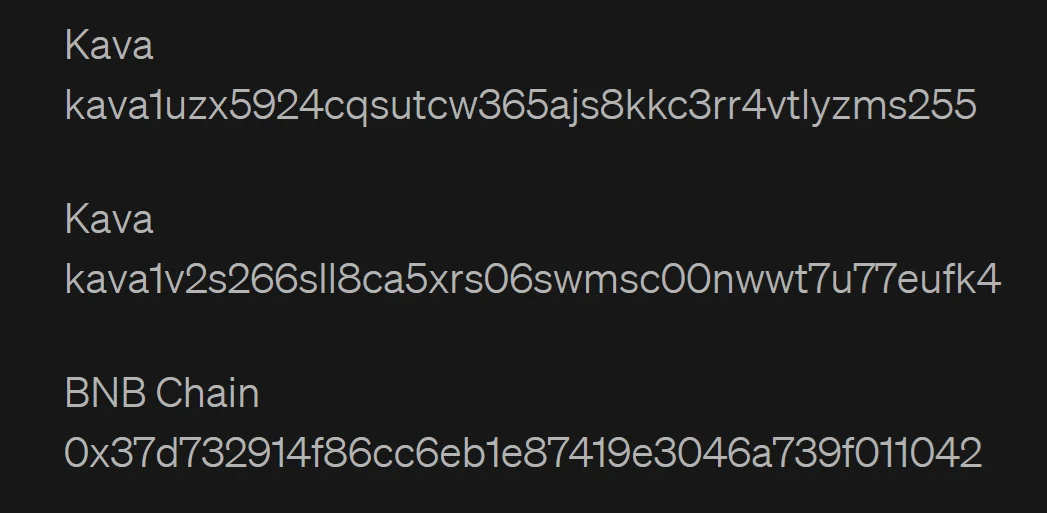
The team also exposed the main addresses tied to the theft, including a BNB Chain wallet ending 011042. They also insisted that the incident was “isolated and contained within Kava Lend,” noting that the attacker did not mint any new tokens and the wider chain was not affected at all.
How did markets react to the KAVA hack?
Kava announced that it had paused its Axelar bridge, even though the stolen KAVA was extracted through LayerZero. Kava described the pause of KAVA deposits and withdrawals by South Korean exchanges Upbit, Bithumb and Coinone as a standard precaution.
Price also moved sharply following news of the exploit. KAVA fell about 40% in a day, going from roughly $0.068 to $0.040. CoinMarketCap listed the token near $0.033 at the time of this report, with a market cap around $36 million.
The Kava team said it is speeding up the retirement of the protocol’s legacy HARD Lend lending features and will file a governance proposal to permanently disable new lending and borrowing, a change that runs through a seven-day KAVA holder vote. Protective measures stay in force while the vote runs, and remaining user positions will be unwound through a separate process, the team said.
The smartest crypto minds already read our newsletter. Want in? Join them.
FAQs
How much was taken from HARD Lend?
Kava Chain says about 53.9 million KAVA was removed from the lending pool, while onchain review put the figure near 55.2 million, worth roughly $3.76 million at the pre-attack price of $0.068.
How did the attacker exploit HARD Lend?
They drove the dormant BUSD market's net supply down to almost zero, triggering an accounting flaw that inflated BUSD collateral about 243,000-fold, then borrowed KAVA against it 127 times.
What is Kava doing about it?
Kava has blocked the vulnerability, frozen part of the stolen funds, and plans a governance proposal to permanently end new lending and borrowing on HARD Lend through a seven-day vote, according to its November 16 incident report.
Disclaimer. The information provided is not trading advice. Cryptopolitan.com holds no liability for any investments made based on the information provided on this page. We strongly recommend independent research and/or consultation with a qualified professional before making any investment decisions.

Hannah Collymore
Hannah is a writer and editor with nearly a decade of blog writing and event reporting experience in the crypto space. At Cryptopolitan, Hannah contributes to the news page, reporting and analyzing the latest developments in DeFi, RWA, crypto regulation, AI and frontier tech industries. She graduated from Arcadia university with a degree in Business Administration.









