




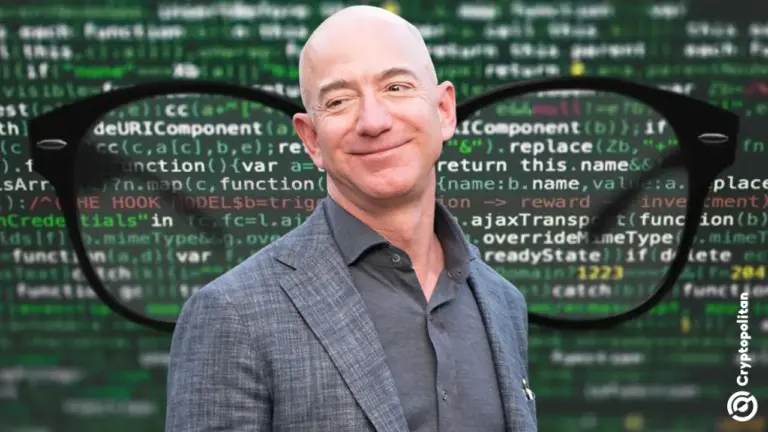
- Jeff Bezos joined a $450 million funding round for UK startup CuspAI, which uses AI to discover new materials for semiconductors and other advanced technologies.
- The investment reflects a shift in AI funding from chatbots to scientific discovery, where AI can accelerate materials research for next-generation chips.
- Success could speed up innovation in semiconductors, batteries, clean energy, and broader AI infrastructure.
Jeff Bezos has joined investors backing UK startup CuspAI in a funding round of about $450 million. Existing investor Temasek also participated, highlighting growing confidence that artificial intelligence can speed up one of the slowest and most expensive parts of technology development: discovering new materials for advanced semiconductors.
This investment is an indicator of the wide-ranging change in the AI competition. While the focus in the sector has been on chatbots and large language models, the future competitive advantage may depend more on the materials behind the development of quicker and better chips.
CuspAI, located in Cambridge, is engaged in the formulation of AI solutions that help to create materials meant for semiconductors, batteries, catalysts, and membranes and has created an AI Materials Foundry that partners with industry players to develop compounds designed for particular goals as opposed to solely using already known materials.
Jeff Bezos backs AI science
There is no guarantee that every material that appears promising actually exists.
This is why scientists are concerned about thermodynamic stability. The measure shows if the crystal structure can withstand time without deteriorating and decomposing into different components. Using modern artificial intelligence models, scientists can calculate the energy state of a material before it is synthesized, thus eliminating non-viable options and making it possible to focus on those with the highest chances of success.
Google DeepMind demonstrated this approach in its 2023 Nature paper on GNoME (Graph Networks for Materials Exploration).
“GNoME discovered 2.2 million crystal structures, including more than 380,000 predicted to be stable.” — Merchant et al., Nature (2023)
The predicted stable materials have been added to the open data Materials Project database, allowing researchers all over the world to do experiments on them.
The idea has been further developed by scientists. In a 2025 article published in Communications Materials, the team working on ME-AI (Materials Expert-Artificial Intelligence) shared an overview of their concept, which combines the expertise of material scientists with machine learning techniques to predict how materials will behave in the future.
“Our framework scales with growing databases, embeds expert knowledge, offers interpretable criteria, and guides targeted synthesis.” — Schoop et al., Communications Materials (2025)
Taken together, these efforts illustrate how AI is changing the process of materials discovery from an expansive search to a focused design process.
Bezos’ investment reflects a broader AI shift
CuspAI did not disclose the amount invested by Bezos or the full list of investors in the latest funding round. Nevertheless, the new financing layer indicates the increasing interest of investors in the application of AI in fields other than software, including science and high-tech manufacturing.
As CuspAI reduces the time spent on new semiconductor materials discovery, faster developments in chip manufacturing can also occur across industries. If materials development accelerates, then progress can occur in batteries, clean energy, industrial chemicals, and the next generation of AI infrastructure. Massive financial support from Bezos suggests that investors have realized that innovations in physical sciences, rather than just better AI models, can be the next step in technology.
If you're reading this, you’re already ahead. Stay there with our newsletter.
FAQs
Who invested in CuspAI?
Jeff Bezos joined other investors in backing CuspAI, which Bloomberg reported was already backed by the Singapore state investor Temasek. Bloomberg did not disclose the investment amount or the full list of participants.
What does CuspAI do?
CuspAI is a Cambridge, England company, registered as Cusp AI Limited, that uses AI for materials discovery and runs an AI Materials Foundry. Its listed focus areas include semiconductor and electronic materials, energy storage and battery materials, catalysts, and membranes.
How is AI used to discover new materials?
AI models predict which new material structures are likely to be stable and useful, narrowing millions of candidates before any lab work begins. Google DeepMind's GNoME system predicted 2.2 million new crystals in 2023 and flagged about 380,000 as stable candidates for experimental synthesis.
Disclaimer. The information provided is not trading advice. Cryptopolitan.com holds no liability for any investments made based on the information provided on this page. We strongly recommend independent research and/or consultation with a qualified professional before making any investment decisions.

Ashish Kumar
Ashish Kumar is a crypto and financial journalist with eight years of newsroom experience. He covers what’s happening with crypto markets, regulation, DeFi, and exchange ecosystems. He has worked with Coingape, Todayq, and Newsroompost. Ashish holds a PGDP in English Journalism from the IIMC. He has also interviewed industry figures including Arthur Hayes, Yat Siu, Austin Federa, and more.