





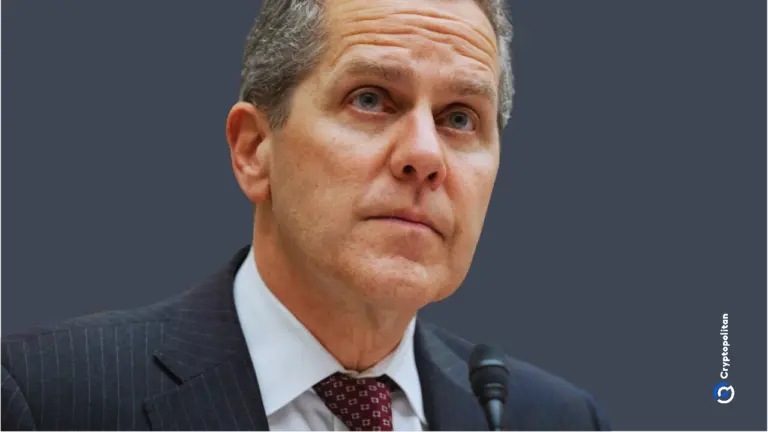
- Federal Reserve Governor Michael Barr warned in a Milan speech that AI could destabilize the financial system.
- He believes this could happen via trading herd behavior, price manipulation by algorithms, circular financing among AI firms, and agents fast enough to accelerate bank runs.
- Roughly 87% of respondents to the Fed’s November 13 stability survey already flag AI as a major risk.
Federal Reserve Governor Michael Barr has warned that artificial intelligence could cause problems for the financial system. He said AI could make traders buy or sell at the same time, allow trading programs to manipulate prices. He added that this could cause people to rush to withdraw money from banks much faster.
Barr gave the warning during a speech at the Seventh Annual Association for Computing Machinery International Conference in Milan, Italy. He did not discuss interest rates or the future of the economy. Instead, he spoke about the growing use of AI in banking, trading, and everyday financial services.
Circular financing in AI boom
Barr also warned about the risks of circular financing. This is when AI companies get money from investors and then spend it on services offered by those same investors. These deals can make the companies look more successful than they really are.
He also raised concerns about how much money companies are borrowing to build AI systems. The Federal Reserve governor pointed to growing financial links between big tech companies, equipment suppliers, and smaller AI firms.
Barr warned that if AI companies grow more slowly or make less money than expected, their financial links could cause problems to spread and become worse.
How an AI agent can start a bank run
Barr also warned about AI tools that can manage money for customers. Banks may generally find it hard to check whether a customer has given an AI tool permission to move money.
Even with permission, these tools could still be risky. Barr stated that they could move money out of bank accounts so quickly that banks may not have time to react. This could cause people to withdraw large amounts of money at once, faster than current bank safety measures can handle.
He also warned that hackers could use AI to attack financial systems. AI tools that stop following their rules could also find and take advantage of weaknesses in those systems.
Herding, manipulation, and biased lending
Barr warned that financial markets could face problems if too many traders use similar AI tools. These tools could make traders buy or sell at the same time, causing sharp price changes. He also said AI trading programs could learn to manipulate prices on their own.
“We need to reduce the risk that AI amplifies bias in consumer lending,” Barr stated during his speech.
He also warned of “collusion and market manipulation, significant market swings, and even trading strategies that create systemic risk.”
Barr added that even AI developers are struggling to keep their systems under control and ensure they give accurate results and follow the law. They also face challenges in explaining how these systems work and making sure they produce consistent results.
AI a risk for 87% of survey respondents
Barr’s speech came shortly after the Federal Reserve released its Financial Stability Report on November 13. According to BigGo Finance, about 87% of those surveyed said AI was a major risk to the US financial system.
They were worried about cyberattacks, complex financial deals involving AI companies, and the possibility that slower AI profit growth could hurt the wider stock market.
Barr spoke just hours before Fed Chair Kevin Warsh was scheduled to open a separate conference hosted by the San Francisco Fed. AI developers, business leaders, and researchers were expected to discuss how AI could affect jobs, productivity, and the economy.
These warnings show growing concerns that AI is spreading through the financial industry faster than regulators expected. As a result, regulators continue to work on ways to monitor the technology and manage its risks.
If you're reading this, you’re already ahead. Stay there with our newsletter.
Disclaimer. The information provided is not trading advice. Cryptopolitan.com holds no liability for any investments made based on the information provided on this page. We strongly recommend independent research and/or consultation with a qualified professional before making any investment decisions.

Opeyemi Olanrewaju
Opeyemi specializes in creating and refining high-quality content focused on cryptocurrency, global financial markets and the economy. He graduated from the University of Ibadan with an MBBS degree. He has worked as Editor-in-Chief for his College’s editorial publication and previously at CFA. For over six years, he has helped safeguard uniqueness as news editor at Cryptopolitan.









