


LATEST NEWS

Best crypto insights delivered straight to your inbox.
LIVE: Bitcoin wobbles while stocks crash as Fed’s Warsh holds interest rates steady

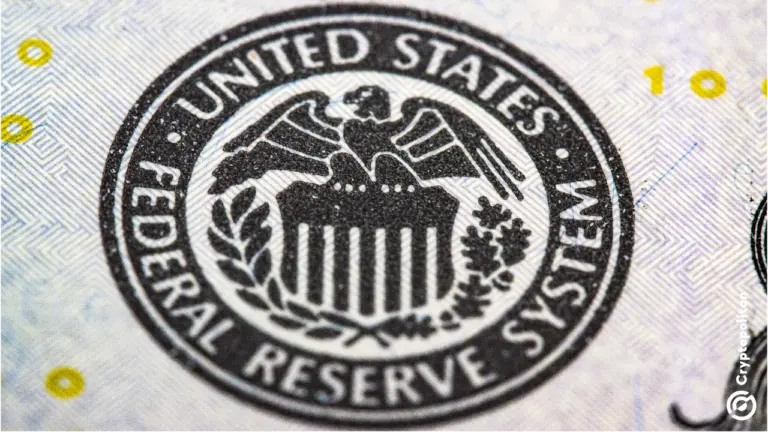

- The Fed held rates at 3.50% to 3.75% in a 9-3 vote, with Beth Hammack, Neel Kashkari and Lorie Logan backing a 25-basis-point hike.
- Kevin Warsh dropped forward guidance and said the Fed’s inflation target is firmly set at 2%, with no softer version of that goal.
- Treasury yields jumped after the decision, with the 10-year above 4.67% and the 30-year above 5.2%, its highest level since 2007.
Live Reporting
Wall Street sold off sharply after the Federal Reserve’s decision, with the Dow Jones Industrial Average losing 1,153.18 points, or 2.19%, to close at 51,594.14. It was the index’s biggest one-day fall since April 2025.
The S&P 500 dropped 1.52% to 7,316.15, while the Nasdaq Composite fell 1.74% to 24,442.94. That left the tech-heavy index more than 10% below its record high.
Semiconductors took another heavy hit. The iShares Semiconductor ETF (SOXX) fell 5.5%, extending its losing run to five sessions. Investors remain uneasy about whether the huge sums being poured into artificial intelligence will generate strong enough returns, while rising competition from China is adding more pressure.
Micron Technology (MU) and KLA (KLAC) each lost roughly 10%, while Advanced Micro Devices (AMD) fell 5.5%.
Crypto prices also moved lower after the Fed announcement. Bitcoin slipped about 1% to $63,890, while Ethereum fell by a similar amount and traded slightly above $1,900.
Crypto-linked shares were mostly in the red. Robinhood Markets (HOOD) fell 3.15% to $89.84, Coinbase Global (COIN) dropped 4.65% to $160.09, and Strategy (MSTR) lost 2.94% to close at $93.33.
Block (XYZ) declined 1.11% to $82.18, Circle Internet Group (CRCL) dropped 4.6% to $61.36, and BitMine Immersion Technologies (BMNR) fell 5.58% to $16.59.
The steepest losses came from crypto miners and infrastructure firms. IREN (IREN) plunged 13.62% to $29.31, Hut 8 (HUT) sank 12.81% to $88.18, Galaxy Digital Holdings (GLXY) dropped 12.8% to $18.26, and TeraWulf (WULF) fell 11.7% to $15.09.
Elsewhere, Net Holding (NTHOL) slipped 1.04% to $43.64, while GameStop (GME) fell 1.44% to $21.84.
Only a few names finished higher. MercadoLibre (MELI) edged up 0.04% to $1,863.31, PayPal Holdings (PYPL) gained 0.05% to $58.35, and Nexon (NEXOY) rose 2.05% to $15.21.
Federal Reserve Chair Kevin Warsh said he will reconnect with the five policy task forces he created last month before traveling to the Fed’s annual research conference in Jackson Hole, Wyoming, next month.
“In the next couple of weeks, I’m going to be doing a check back in,” Kevin said. He added that the groups have had time to work through their priorities, internal debates, schedules and when their findings may be ready for public discussion.
Kevin said those conversations might shape what he says at Jackson Hole, though he has not started preparing the speech.
“I’d like to also frame the big questions,” he said, adding that frequent meetings and press conferences can leave policymakers “caught up in the myopic.”
Kevin introduced the five task forces during his first press conference as chair. Their reviews cover the Fed’s treatment of inflation, public communications, economic data, productivity, the labor market and the central bank’s balance sheet.
One panel will deal specifically with the balance sheet, which Kevin has repeatedly argued is larger than it should be.
The Fed selected 15 people earlier this month to lead the groups. They include Harvard University economics professor Raj Chetty, technology investor Marc Andreessen, and former central bank governors from Brazil, England and India.
The panels will have access to Fed employees and resources, but the central bank said they will “operate independently.”
Federal Reserve Chair Kevin Warsh said officials will keep watching how investors react as fresh economic developments unfold. He noted that markets are moving in real time and will make their own calls before the Fed meets again in roughly seven or eight weeks.
“Markets are reacting in real time. We’ll be continuing to watch that market information, see how it responds to incoming events.”
He said those moves could help shape the Fed’s thinking when policymakers return for their next rate meeting.
Kevin also said the central bank is focused on separating temporary price shocks from deeper inflation pressures. Officials are studying whether recent disruptions are spreading into areas of the economy that were not directly affected at first.
“We take these shocks seriously. We’re not looking through them and saying, ‘Oh, they don’t matter.’”
Kevin added that the Fed is trying to judge how widely those pressures are reaching and whether they are lifting prices far beyond the original source of the disruption.
He said the repeated shocks hitting the economy have made the Fed’s job harder.
Kevin rejected the idea that July’s decision was simply a pause in the rate cycle.
“I wouldn’t characterize what we did as anything like a pause. I would characterize what we did as a rigorous review of the economic situation.”
He added that officials spent the meeting working through the biggest and most difficult policy questions. Kevin said describing the outcome as a pause would likely prompt financial markets to price in a different message.
Federal Reserve Chair Kevin Warsh said forward guidance can box policymakers in when economic conditions change quickly.
Since taking charge, he has pushed the Fed to say less about its next move so officials can react more freely to new data.
Kevin also said reading signals from financial markets is never an exact science.
Before the decision, traders saw a 65% chance that rates would stay where they were and a 35% chance of a hike. That was one of the most uncertain setups ahead of a Fed announcement in years.
Asked what drove the three dissenting votes, Kevin said the meeting delivered the disagreement he had wanted.
“I got the good family fight I asked for,” he said. “That’s the purpose. That’s the design feature.”
Kevin said most of the two-day meeting focused on the larger questions shaping monetary policy, rather than minor wording changes or short-term market moves.
“It was a real family fight,” he said.
He described the debate as “an active, robust discussion” covering the full range of steps the Fed could take in the months ahead.
Before becoming chair, Kevin had argued that less orderly meetings, where officials openly challenged one another and worked through their differences, could produce stronger decisions.
Federal Reserve Chair Kevin Warsh said officials held a “vigorous discussion” before voting on rates, with the conversation built around four broad questions.
The first was whether the inflation surge of the past five years is still shaping today’s policy choices.
“Has the past really passed?” Kevin asked after outlining how long prices have remained above the Fed’s target.
Officials also examined the run of major shocks that have hit the economy, including pandemic-era supply problems, wars, energy disruptions, higher tariffs and the wave of spending tied to artificial intelligence.
“These differ in their sources,” Kevin said. “Do they also differ in their effects on output and employment?”
The remaining two questions focused on how temporary shocks feed into prices and whether the Fed’s current tools and policy methods are still suited to the economy it now faces.
Kevin also said the central bank is trying to read financial markets without distorting the signals coming from them.
“What I’ve really been trying to do is get an unfiltered message from markets,” he said, pointing to trading in Treasuries and the US dollar.
“We’re trying not to interfere with that market signal,” Kevin added.
He linked that approach to the Fed’s decision to use fewer words and abandon forward guidance, saying markets have been responding more directly to fresh developments during the 42 days since officials last met.
“This is a good thing,” Kevin said.
Federal Reserve Chair Kevin Warsh opened his press conference by making clear that the central bank will no longer spell out where rates may be heading.
The new approach strips future policy signals from the statement and keeps the focus on the decision in front of officials.
“The policy statement conveys just the facts. It’s steering clear of forecasting, a choice we consider especially prudent at these uncertain times,” Kevin said. “Uncertainty, however, does not mean a lack of clarity.”
The change began after Kevin took over at the Fed, when officials replaced the usual policy language with a much shorter statement that avoided hinting at the central bank’s next move.
Kevin also pushed back against any suggestion that the Fed could tolerate inflation staying above its formal goal.
“Let me reiterate there is no soft inflation target. There is no soft implicit target. Not on this committee’s watch,” he said. “There’s only a target and it’s 2%.”
He acknowledged that the central bank is dealing with more than five years of inflation running above that level and said the problem will not disappear quickly.
“We have begun a new chapter, and we understand that the five plus years of inflation above target cannot be cured in nine weeks, or by a single month of modest price decreases,” Kevin said. “This Fed will not waver.”
The Federal Open Market Committee voted 9-3 to keep the federal funds rate within its current 3.50% to 3.75% range, leaving monetary policy unchanged at Kevin Warsh’s second meeting as Federal Reserve chair.
The Fed also said it will continue supplying the banking system with enough reserves to keep short-term funding markets running smoothly.
Officials described the economy as still growing at a healthy pace, even with uncertainty tied partly to the conflict in the Middle East.
They pointed to strong productivity, continued business investment and a labor market where hiring has broadly matched growth in the available workforce. The unemployment rate has barely moved.
Inflation remains above the central bank’s 2% target. The Fed said recent supply disruptions have pushed up prices in parts of the economy, including the energy sector, and repeated its commitment to bringing inflation back under control.
Beth M. Hammack, Neel Kashkari and Lorie K. Logan opposed the decision. Each wanted the Fed to raise the benchmark rate by 25 basis points at this meeting.
Treasury yields moved sharply higher after the announcement. The 10-year yield climbed 7 basis points to more than 4.67%, while the 30-year yield jumped 10 basis points above 5.2%, reaching its highest level since 2007.
The Dow Jones Industrial Average rallied on Tuesday as strong corporate earnings, falling oil prices and a shift away from semiconductor stocks pushed money into other corners of the market.
The Dow gained 537.24 points, or 1.03%, to close at 52,747.32, its third consecutive winning session.
The S&P 500 rose 0.21% to 7,428.78, while the Nasdaq Composite fell 0.22% to 24,876.91, as tech stocks continued to fall.
The VanEck Semiconductor ETF (SMH) fell more than 3%, marking its fourth consecutive loss day. Micron Technology (MU) and Advanced Micro Devices (AMD) each dropped more than 8%.
Lower oil prices helped support the broader market after Iran discussed the Strait of Hormuz with Saudi Arabia and Oman. West Texas Intermediate crude fell about 4% to settle at $79.26 per barrel, while international benchmark Brent crude dropped 4.8% to $84.09.
Investors are now awaiting the Federal Reserve’s interest-rate decision, which is largely expected to hold its benchmark lending rate steady, despite continued inflation making the outlook for the remainder of the year more dubious.
A hold is not completely priced into the market. The CME FedWatch Tool shows a nearly 30% chance of a 25-basis-point rate increase, up from roughly 15% one week ago.
Bitcoin, meanwhile, is showing some of its clearest signs yet that it may be forming a long-term bottom after months of weakness. The cryptocurrency has traded around the $60,000 level for almost two months after falling below $70,000 at the beginning of June.
It remains about 50% below its October record of roughly $126,000. Bitcoin’s advance toward $83,000 in May was viewed as an opportunity to reduce exposure before another period of long-term weakness. Since then, the price has held above $58,000 after surrendering about 60% of the gains recorded during the 2022-to-2025 rally.
Wolfe Research analyst Read Harvey said Bitcoin remains in a broader downtrend and expects the recent move toward $65,000 to lose momentum before another decline.
“Price remains in a clear downtrend beneath the downward sloping 200-day moving average, which it has failed to eclipse since losing it in November,” Read told CNBC.
“We expect this latest stretch of relief to ultimately stall out below the 200-day moving average and reverse to make a new leg lower – as we have already seen play out multiple times this year.”
Read also follows the view that Bitcoin moves in a four-year cycle, historically consisting of three rising years followed by one declining year. Under that pattern, he believes the cryptocurrency could fall below $40,000 in October before reaching a bottom.
What to Know
The Fed stayed put, but Kevin made clear that inflation, market signals and the next round of policy decisions are still very much in play.
TABLE OF CONTENT
Share this article

MORE … NEWS










DEEP CRYPTO
CRASH COURSE
- Which cryptocurrencies can make you money
- How to boost your security with a wallet (and which ones are actually worth using)
- Little-known investment strategies that the pros use
- How to get started investing in crypto (which exchanges to use, the best crypto to buy etc)