


LATEST NEWS


Best crypto insights delivered straight to your inbox.
LIVE: US dollar crashes after Trump admin sidestepped it in surprise yen intervention for Japan

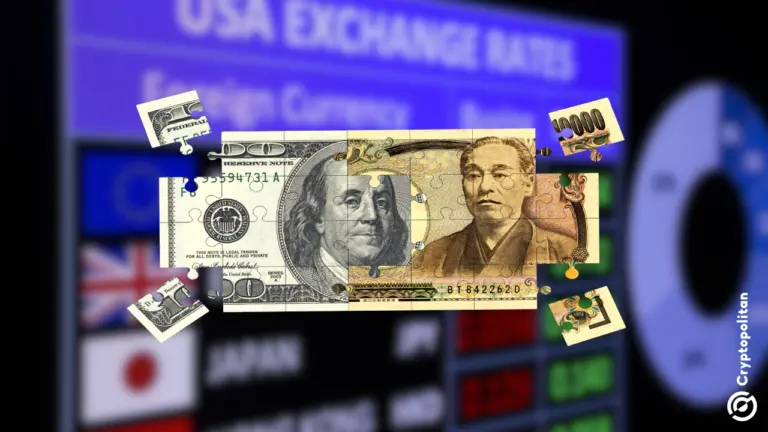

- The U.S. dollar slid from above 163 yen to around 156 after Washington and Tokyo confirmed joint intervention.
- Japan is trying to curb the yen’s inflationary weakness, while the U.S. also sees economic and trade benefits.
- Tokyo plans to use the Fed’s FIMA repo facility, avoiding Treasury sales that could disrupt U.S. funding markets.
- The U.S.-Japan rate gap remains intact, meaning pressure on the yen could return despite the intervention.
Live Reporting
Prediction-market traders remain cautious about the chances of Washington and Tehran settling their nuclear dispute soon, even after U.S. President Donald Trump said both sides would hold talks on Monday.
Sentiment on Kalshi improved after Trump scrapped a planned military operation against Iran late Saturday. He announced the decision on Truth Social after Saudi Arabia, the United Arab Emirates, Qatar and Iran urged the U.S. not to launch the strikes.
The probability of an agreement being completed before January 2027 climbed from 17% on Saturday evening to 29% on Sunday. A separate contract covering the period before March 2027 rose from 20% to more than 40% over the same stretch.
Kalshi says those contracts will settle in favor of a deal only when the U.S. formally agrees to, signs or accepts a nuclear pact with Iran.
Still, confidence faded after Trump confirmed that negotiations would restart Monday. Every Kalshi contract tied to an earlier deadline remained below 50%, showing that traders still see failure as the more likely outcome.
The only contract priced above an even chance covers an agreement before January 2029, the latest deadline currently offered on the platform.
American manufacturing picked up sharply in July, suggesting factories are beginning to work through the drag from tariffs. The latest figures also pointed to stronger hiring, although business leaders remain worried about trade policy and the war involving Iran.
The Institute for Supply Management’s manufacturing index rose to 55.6, its strongest reading in more than four years and the highest since May 2022. Economists had expected 54.0. Any result above 50 means more companies reported improvement than contraction.
Factories received more overseas orders, built up larger order backlogs and increased output. The production measure jumped 6.3 points. Employment also expanded for the first time in 33 months, reaching its best level since August 2022.
Costs remained a problem. The prices measure eased slightly to 71.1, showing that close to three out of every four surveyed companies were still paying more for supplies. July was the 22nd month in a row in which most respondents reported rising prices.
Purchasing managers also described a business environment that has become difficult to plan around. Tariff changes and the conflict with Iran have forced companies to keep adjusting orders and supply decisions, with some executives saying the uncertainty feels worse than it did during the Covid pandemic.
After the manufacturing data was released, Goldman Sachs raised its estimate for annualized U.S. growth in the third quarter to 2.4%. Its original projection for the second quarter had been 1.5%.
Markets were less convinced that stronger factory activity guaranteed another increase in interest rates. Traders were still trying to interpret Warsh’s remarks from last week, which offered little clarity on what the Federal Reserve might do next.
Futures pricing put the chance of a rate increase at the Sept. 15-16 FOMC meeting at 64.5% on Monday, slightly below Friday’s level, based on CME Group’s FedWatch tool.
U.S. President Donald Trump said talks with Iran are due to start on Monday after he paused another round of military action against the country. The decision revived expectations that diplomacy could ease a conflict that has disrupted global energy flows.
Speaking to reporters aboard Air Force One on Sunday, Trump said the discussions would begin the following afternoon. He did not say where they would be held or identify who would take part.
Trump said Saudi Arabia, the United Arab Emirates, Qatar and Iran had all asked Washington not to proceed with the strikes. He also said an agreement involving the Strait of Hormuz and Iran’s nuclear program was “imminent.”
Iran, however, gave a different account. Iranian Foreign Ministry spokesperson Esmail Baghaei said Monday that Tehran had no immediate plan to hold direct talks with the U.S. Esmail said Iran was only speaking with Oman about the Strait of Hormuz.
Trump had said on Saturday that the canceled military operation would have been the largest since World War II. He also made clear that the U.S. remained prepared to attack Iran.
The Strait of Hormuz carried roughly one-fifth of the world’s oil supply before the war. Shipping through the route has since fallen sharply, with brief increases in vessel traffic whenever headlines point to possible progress.
Oil prices dropped as traders reacted to the latest diplomatic signals. West Texas Intermediate crude for September delivery fell almost 6% to $79.66 a barrel, while Brent crude for October delivery declined 5.16% to $83.39 a barrel.
The U.S. 10-year Treasury yield has climbed by nearly 57 basis points since the start of the year, adding another layer of strain to global bond markets.
Japan had already tried to support the yen earlier this year, but those efforts barely changed its direction. Currency prices are usually set by trading activity, although interest rates, policy decisions and investor demand can all push them one way or another.
The wide gap between borrowing costs in the U.S. and Japan has been one of the biggest forces working against the yen. Investors have been selling the Japanese currency and buying dollars so they can earn higher returns from U.S. assets.
That gap stayed in place after both the Bank of Japan and the Federal Reserve left rates unchanged at their meetings last week. When the dollar later dropped below 160 yen and remained there, traders began to suspect that Washington had joined Tokyo’s effort.
Neil Newman, managing director and head of strategy at Astris Advisory Japan, said it is unusual for governments to openly confirm this kind of action. Neil pointed to the coordinated response after Japan’s devastating 2011 earthquake and tsunami as the last major example.
Asked on Sunday why the U.S. had helped, Trump said, “We have a good relationship with Japan. We’re very strong — very, very strong financially — and they are, you know, they have a weakening yen, and they wanted a little bit of help, and we’re always there for Japan. Japan’s been very good to us, with the exception, of course, of Pearl Harbor.”
Trump also said the U.S. received a “financial benefit” from the deal and described it as a “signal of friendship.”
“It’s also good for the world economy,” Trump said.
A softer dollar lowers the price of American products for Japanese buyers, which could make U.S. exports more competitive in Japan. Neil said that gives Washington an economic reason to support the effort.
“It’s very rare that the Americans will work with the Japanese on this, but there is an alignment of interests here basically between Japan and America,” Neil said.
The U.S. dollar weakened sharply against the Japanese yen on Monday after U.S. President Donald Trump and Japan’s finance minister confirmed that both countries had intervened in the currency market.
The greenback was previously trading above 163 yen, touching highs not witnessed in some 40 years, before the past week-end, when it started dropping below 160 yen amid growing suspicions of government intervention.
The greenback fell to around 155.20 yen following the announcement of the intervention early Monday and then recovered to touch 156.75 yen by late Monday afternoon in Tokyo. That was well below the high from last week.
While the weakening of the yen has been luring millions of bargain hunters to Japan, it has increased the cost of imports.
Japan relies heavily on imports, and the weaker currency has pushed up domestic prices. High oil costs have added to the pressure, leaving Japanese Prime Minister Sanae Takaichi’s government facing growing demands to ease the cost-of-living squeeze.
Louise Loo, head of Asia economics at Oxford Economics, said inflation pressure in Japan was “possibly one of the key reasons” Washington agreed to take part. Louise said the U.S. also had its own interests to protect.
“There is a self-preservation element here. Volatile markets driven by potentially fiscally-aggressive policies from Japan could extend to the U.S. Treasury markets, destabilizing the dollar.”
Louise said the focus from Tokyo and Washington on the Federal Reserve’s standing FIMA repo facility suggested both sides wanted to avoid forced Treasury sales. The facility allows foreign central banks to obtain dollar liquidity without selling their U.S. government bond holdings outright.
Japan’s finance ministry said Monday that it plans to use the FIMA facility in future interventions. Masahiko Loo, senior macro strategist at State Street, said that message “may be bigger than the intervention itself.”
Masahiko stated that Washington’s worries may not end with the yen. A further depreciation of the currency will only spur the selling of Japanese bonds, increasing interest rates and creating volatility in the international bond market. This is even more critical when both Japan and America are grappling with high long-term interest rates.
“Highlighting access to the Fed’s FIMA repo tells markets Japan can raise dollar liquidity without selling Treasuries … addressing concerns that MOF intervention could pressure U.S. funding markets through short-end UST sales,” Masahiko said. “It’s an attempt to maximize the signaling effect and get the biggest bang for the buck with the tools already available.”
What to Know
The dollar is taking a rare hit as Washington helps Japan defend the yen without rattling global bond markets.
TABLE OF CONTENT
Share this article

MORE … NEWS










DEEP CRYPTO
CRASH COURSE
- Which cryptocurrencies can make you money
- How to boost your security with a wallet (and which ones are actually worth using)
- Little-known investment strategies that the pros use
- How to get started investing in crypto (which exchanges to use, the best crypto to buy etc)