







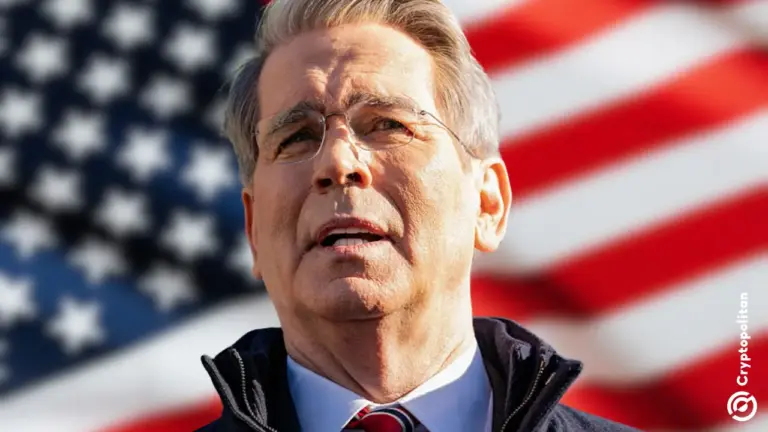
- Scott Bessent will meet He Lifeng in New York this weekend to discuss AI, rare earths and trade ahead of the September 24 Trump-Xi summit.
- The extent of the agenda shows the US-China rivalry now covers the entire technology stack, from open-weight models to chips, minerals and infrastructure.
- For companies and other countries, the outcome will shape whether AI markets stay connected or split into competing US and Chinese ecosystems.
US Treasury Secretary Scott Bessent is expected to engage in discussions with the Vice Premier of China, He Lifeng, about AI, rare metals, and trade. The fact that these issues are being discussed together indicates that AI has become an intrinsic part of the larger U.S.-China economic competition.
AI policy is now welded to the whole economic fight
The meeting comes days before President Donald Trump and Chinese President Xi Jinping are due to meet in Washington on September 24. Reuters, citing a source familiar with the plans, said the Bessent-He talks could continue at a technical or working level into Monday. The Associated Press first reported the US plans.
The agenda indicates that AI has now become part of the broad economic link between the countries. Manufacturing and operating sophisticated models involves the use of chips, data centers, energy sources, and key minerals, which means that disagreements over AI impact trade and industrial regulations across borders.
The same interdependence motivates both parties to maintain a certain level of communication between them. Despite the tensions between Washington and Beijing, which arise in relation to technology and supply chain issues, Bessent stated that there might be opportunities to limit their mutual threat. He told Axios:
“We are open to discussions on avoiding shared risks and avoiding bifurcation of our two systems.” — Scott Bessent, US Treasury Secretary
Chinese open-weight models are the new competitive front
Bessent said the talks should cover both open- and closed-weight models. Open-weight systems make their trained model weights available for others to download, run or fine-tune, although licenses and disclosure levels differ.
This difference has gained significant commercial value. According to Reuters, Chinese open-weight models are drawing the attention of American buyers due to their lower prices than the closed-type models from American labs. CSIS reported that the Chinese solutions comprised 41% of the Hugging Face downloads in the last year. Moreover, CSIS noted that Z.ai‘s current GLM-5.2 model, which has around 750 billion parameters, is very competitive when it comes to coding and agent performance compared to the top closed models made in the US.
The gap in capabilities has also diminished. According to Stanford’s 2026 AI Index, in March the top US AI model was only 2.7% ahead of the top Chinese model, continuing the trend since the beginning of 2025, when the two models regularly exchanged their positions on top of the list.
The tension even reached the US government as it is reported by Reuters that the National Archives website utilized Alibaba’s Qwen model to search for proposed federal regulations. At the same time, the FBI accused Alibaba of stealing Anthropic’s technology.
Rare earths give Beijing leverage that takes years to unwind
Rare earths are important as they are the sources of permanent magnets and other components that can be employed in advanced manufacturing. In 2025, China introduced export limitations that had severely impacted defense, semiconductor, and automotive supply chains before the United States and China leaders reached the decision to suspend these restrictions for a year.
Washington has taken action through financial support, production agreements and price subsidies to facilitate the establishment of dire alternative sources. According to CSIS, one of the agreements signed by the US government with MP Materials includes a decade-long arrangement establishing a neodymium-praseodymium production floor set at $110 per kilogram. However, it will take years for new vertically integrated mine-to-magnet supply chains to emerge outside of China.
The stacks are drifting apart, and the money is enormous
BCG states that new AI ecosystems devoted to the US and China are being formed that will impact AI systems, cloud services, processors, and applications. This creates some issues for governments and businesses operating outside the two countries. They have to consider how long they can keep using technologies developed in both countries before regulations on exports, security, and procurement come into effect.
The amount of money involved is tremendous. PwC forecasts that by 2050, the amount of investment in global AI infrastructure will amount to $31.6 trillion, with the United States accounting for $15.1 trillion and Asia Pacific for $8.2 trillion. It also estimates that disruption to chip trade could lead to a reduction in investment globally of almost 20%.
What to watch before the Washington summit
Axios says Washington is open to discussing “shared risks” with Beijing, while Cryptopolitan previously reported preparations for AI-focused talks ahead of the September 24 summit. The Associated Press says expectations for a major AI agreement remain low amid mutual distrust.
What matters now is whether the New York talks produce even a narrow set of practical guardrails while the much bigger contest over chips, minerals, trade and AI continues.
The smartest crypto minds already read our newsletter. Want in? Join them.
FAQs
Who is meeting, and when?
US Treasury Secretary Scott Bessent will meet Chinese Vice Premier He Lifeng in New York City this weekend, according to Reuters, ahead of a September 24 summit between President Trump and President Xi in Washington.
What will Bessent and He discuss?
Reuters reports the talks will cover AI, trade, rare earths and other economic issues, and Bessent said in a statement he expects them to address both open- and closed-weight AI models.
Why are Chinese open-weight AI models a growing concern for the US?
US companies increasingly use Chinese open-weight models because they can be cheaper than closed US tools, and CSIS says Chinese models made up 41% of Hugging Face downloads over the past year while closing most of the capability gap with leading US systems.
Disclaimer. The information provided is not trading advice. Cryptopolitan.com holds no liability for any investments made based on the information provided on this page. We strongly recommend independent research and/or consultation with a qualified professional before making any investment decisions.

Ibiam Wayas
Ibiam Wayas has covered the crypto news beat since 2019. He studied Computer Science at National Open University of Nigeria. His work has appeared on various crypto news platforms, including Coinfomania, Crypto News Australia, and AltcoinBuzz. Drawing on his background in Computer Science, he now focuses on crypto, robotics, and longevity news.









