





- China and the US are set to hold AI discussions.
- President Trump had previously called warnings about unchecked AI a hoax.
- Szalwinski noted that it will be challenging to decouple AI safety from overall U.S.-China hostility.
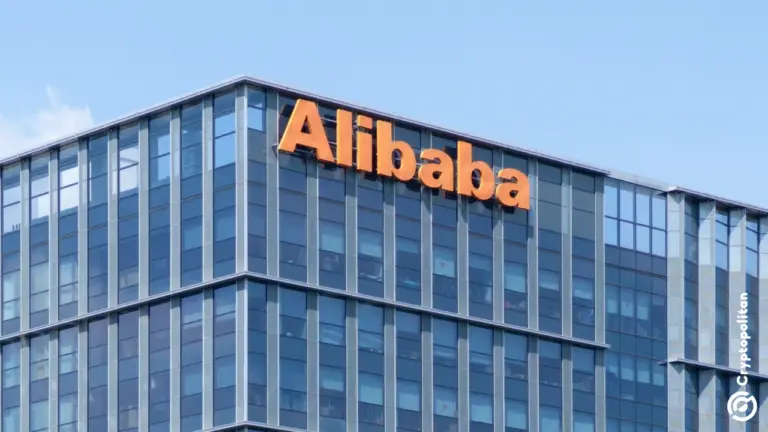
Alibaba Group is launching a massive new AI processor, the Zhenwu V900. The company claims it will be China’s top-performing chip, putting it in direct competition with Nvidia.
CEO Eddie Wu further asserted that the new hardware delivers three times the performance of the last generation, the Zhenwu M890, and can scale to 500,000 units for advanced AI training.
The executive also mapped out their long-term vision, aiming to reach 20 gigawatts of global data center capacity for Alibaba Cloud by 2032 to keep pace with skyrocketing AI demand.
Alibaba’s move is significant because China has been trying to build a stronger domestic AI computing ecosystem as access to Nvidia’s most advanced processors becomes increasingly restricted.
Alibaba has been developing its own semiconductor capabilities through its T-Head unit, while also expanding its cloud infrastructure to support AI workloads.
The Zhenwu V900, therefore, represents more than a single new processor. It forms part of Alibaba’s broader attempt to control more of the computing stack required for large-scale AI development, from chips and cloud infrastructure to foundation models and AI agents.
The company’s ability to manufacture and deploy these processors at scale will be an important factor in determining how effectively it can support increasingly demanding AI workloads.
Wu rolled out other new features at the Aspara conference
Speaking at the firm’s Apsara Conference, Wu pointed to strong customer demand for AI and the firm’s new focus on expanding its infrastructure. The firm has already committed more than $53 billion to a three-year buildout, backed in part by a $10.2 billion stock offering in Hong Kong in August.
Aside from its 20GW plan and new processor, the company also rolled out a series of new AI products at the conference, including Qwen foundation models, multimodal models, a purpose-built agentic cloud, and a mobile AI agent platform.
Also at the conference, Joe Tsai, Chairman of Alibaba Group, insisted on the company’s AI vision. “AI possesses vast potential for development–it can be deployed and scaled in real-world scenarios, boosting productivity across thousands of industries,” he said.
Wu also asserted: “Last year, we asserted that the more capable AI becomes, the more powerful humanity will be. Today, I remain steadfast in that conviction.”
The new Alibaba product announcement comes right as AI stocks were pushing higher globally. Shares of Alibaba climbed over 5% in Hong Kong trading, while WeChat’s parent company, Tencent, saw a massive rally of over 7%.
At the moment, market sources claim the firm is looking to train a massive AI model with somewhere between 5 trillion and 10 trillion parameters. Moreover, annual shipments for its T-Head AI chips are already projected to scale up significantly.
Washington accused Alibaba of distillation
Alibaba has been at odds with the U.S. government for some time now. More recently, U.S. officials leveled new allegations against Alibaba and DeepSeek, claiming the companies improperly obtained knowledge from leading U.S.
AI models to advance their own technology. China has dismissed the claims and warned of countermeasures if Washington weaponizes them against Chinese firms.
In a startling joint statement, the FBI, NSA, and CISA revealed that Chinese tech giants have been methodically mining top-tier U.S. AI models for over two years. The agencies claim that proprietary data from ChatGPT, Gemini, Claude, and Grok was used as a blueprint for China’s own systems.
The U.S. has a long history of calling out China for stealing corporate secrets. Though with the latest accusations, the U.S. government noted that Chinese officials were likely aware of the widespread AI scraping, but it didn’t explicitly accuse China’s intelligence agencies of running the operation.
The White House often portrays the U.S. and China as competing for the lead in cutting-edge AI. Nonetheless, President Trump is scheduled to meet Xi Jinping on September 24. AI is set to dominate talks at the meeting, a point driven home by the inclusion of tech bosses like Nvidia’s Jensen Huang and Microsoft’s Satya Nadella at an upcoming White House state dinner.
So far, China seems to advocate that the two countries should collaborate more. “We always believe that all parties should strengthen cooperation to foster open, inclusive, beneficial, and ethical development of AI for the well-being of all humanity,” the spokesperson at the Ministry of Foreign Affairs, Mao Ning, noted.
If you're reading this, you’re already ahead. Stay there with our newsletter.
FAQs
What is Alibaba’s Zhenwu V900 chip?
The Zhenwu V900 is Alibaba’s new AI processor, which the company says delivers three times the performance of its previous-generation Zhenwu M890 chip. Alibaba says the processor can scale to 500,000 units for advanced AI training.
How much is Alibaba investing in AI infrastructure?
Alibaba has committed more than $53 billion to a three-year expansion of its AI and cloud infrastructure. The company also plans to build up to 20 gigawatts of global data center capacity by 2032.
Is Alibaba competing with Nvidia in AI chips?
Alibaba is developing its own AI processors as China seeks greater domestic computing capacity amid restrictions on access to advanced Nvidia chips. The Zhenwu V900 is part of Alibaba’s broader strategy to combine its own hardware with cloud infrastructure and Qwen AI models.

Nellius Irene
Nellius is a Business Management and IT graduate with five years of experience in the cryptocurrency industry. She is also a graduate of Bitcoin Dada. Nellius has contributed to leading media publications, including BanklessTimes, Cryptobasic, and Riseup Media.









